


Financial Independence: Moving from Anxiety to Self-Empowerment
Many people experience financial anxiety – fear and worry about money that can lead to stress, impulsivity, and avoidance behaviors that end up making matters worse rather than better. But the way to alleviate that anxiety isn’t to work harder. It’s to work smarter, by gaining the financial literacy skills that will put you on a path to self-sufficiency.
Financial literacy, or the ability to make informed decisions about money management, is a key pillar of Deliverance Charity’s Rebuild Program. With guidance and resources on budgeting, investing, borrowing, we help make it easier for participants to set achievable, long-term goals that ultimately lead to their financial freedom.
But you don’t have to be a potential program participant to take control of your finances. Below are several ways we’ve found to help jumpstart your journey to financial freedom.

Top 3 Tips for Financial Independence
There are lots of tips out there about how to successfully manage your finances.
Deliverance Charity Recommends Starting with The Following 3 Tips for Financial Freedom
-
Tracking what you spend each month helps you identify where money may be wasted and where you could save. It also helps you plan for recurring and unexpected expenses. Most importantly, budgeting encourages intentional spending by helping you understand how much money you have and what you’ll need for the rest of the month.
-
Life is unpredictable, regularly setting aside even a small amount of money can greatly improve your long-term financial stability. Savings allow you to make decisions with confidence and avoid relying on high-interest loans or credit cards when unexpected expenses arise.
-
With loans and credit card debt, a large portion of your payments goes toward interest rather than the balance. Paying down debt helps you avoid paying more than you originally borrowed and allows your money to start working for you instead of against you.
These steps could help you achieve financial independence quicker and with less financial burden.
Goal Setting and Personal Development

Setting achievable goals benefits not only your financial growth and stability, but your personal growth as well, two things that are often deeply connected. By setting clear goals to achieve financial independence, you can more easily visualize the steps you need to take to achieve financial independence, giving you a greater sense of direction and control over your life.
Just as important as setting goals is evaluating your progress as you work to achieve them. The willingness to reflect honestly on both financial successes and setbacks encourages growth on a personal and professional level. This type of self-reflection is essential because it helps you recognize your strengths, identify areas for improvement, and continue developing to your full potential. As your confidence and skills grow, so too does your ability to make informed, thoughtful financial decisions, increasing the ability to gain financial independence and freedom.
The Benefits of Mentorship On Financial Independence

Mentorship can also be a powerful tool in attaining financial independence if achieving personal growth feels too difficult or complicated to navigate alone. A mentor can provide guidance, encouragement, knowledge, and accountability, helping you clarify goals and stay focused as you work toward them. Anyone who has faced a significant hardship knows that asking for help is not a weakness; it’s often one of the most important steps toward overcoming challenges!
There are several ways to find a mentor as you work toward financial independence, including seeking support from nonprofit organizations. Deliverance Charities, for example, hopes to offer the Rebuild Program, designed to promote self-sufficiency and inspire independence and economic growth for all participants. If you’re looking to learn more about your finances and what you can do to manage them, Deliverance Charities recommends Consolidated Credit, a Fort Lauderdale-based organization that helps people find relief from their credit card debt.
Only when you truly understand your finances –and yourself – can you move from fear to empowerment. So empower yourself today. Take your first step toward financial independence and begin your journey to self-sufficiency.
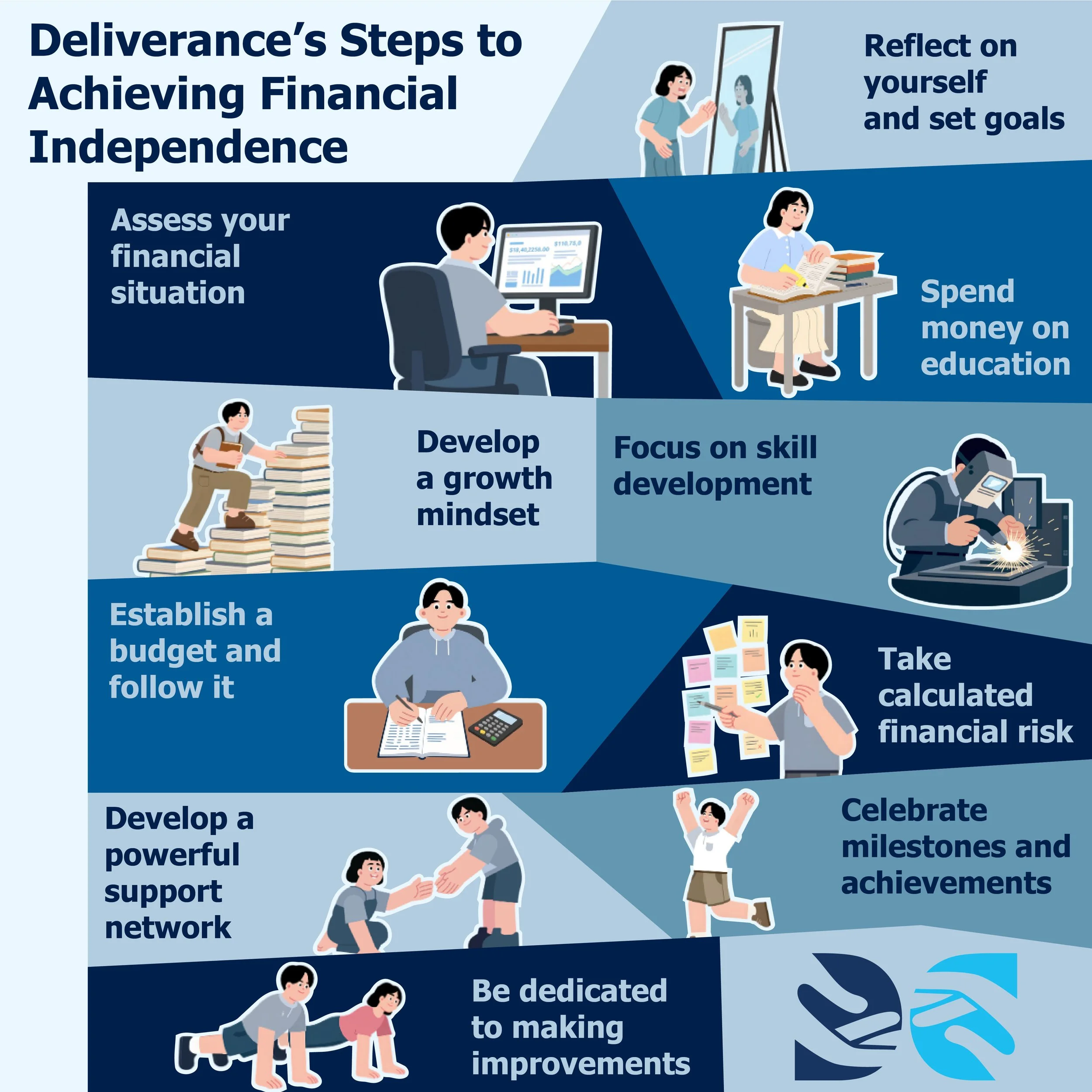
Personal development is the process of improving one’s abilities, mindset, knowledge, and skills in order to realize one’s full potential.
FAQs:
-
There is no objective best place to start. This is all about getting you thinking and moving forward. If creating a budget sounds easiest, start there. If finding a mentor seems more fitting for you, start looking for people. Whatever sounds like a good fit is where you should begin.
-
A search for organizations near me that can help me achieve financial literacy will give you multiple options based on your state, city, or town.
-
That depends on you and the people around you. If you want advice, input, or feedback from others, you can discuss your plan with them. If you feel like this is something you want to handle yourself, however, there is nothing wrong with keeping it close to the chest. This journey is a personal one, so there is no right or wrong amount of people you choose to include along the way.
-
That can sometimes happen and might be expected. Determination to succeed can get you a long way, but you also need to put in the hard work. If you need a more physical representation of your progress, a simple ‘to do’ or ‘have done’ list can make it easier to stay focused and be successful.
-
Just keep looking! A mentor can be anybody, and not necessarily the “Old Wise Sage” one might be picturing in their head. Sometimes connecting with a mentor online can be less intimidating than visiting someone in person. There may already be someone in your life who will be willing to help you as well.